
Marbella guide · Wildlife & Nature
Wildlife & Nature
Guanacaste's dry tropical forest meets the Pacific here, and the wildlife along the coast is remarkable if you know when and where to look. Click any thumbnail to open its Wikipedia page.
Mammals
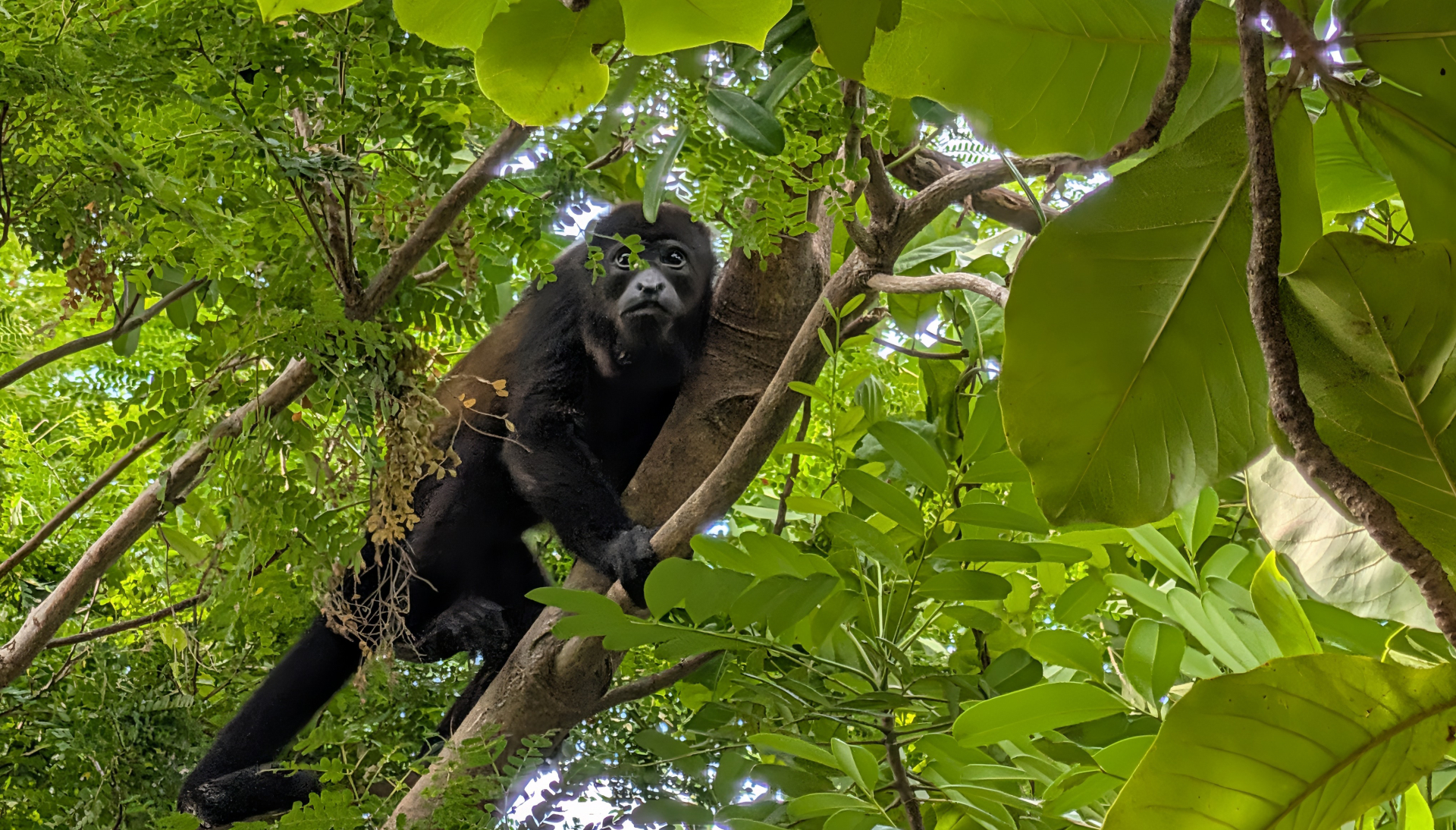
- …Mantled Howler Monkey
The loud, deep-throated howl you'll hear at dawn and dusk is this monkey, common in the trees around Marbella.
- …White-headed Capuchin
An intelligent, highly active monkey often seen foraging in small troops.
- …Central American Spider Monkey
A long-limbed monkey known for swinging swiftly through the canopy.
- …White-tailed Deer
Costa Rica's most widespread deer species, often spotted at forest edges.
- …Collared Peccary
A wild, pig-like mammal that travels in small herds.
- …White-nosed Coati
A raccoon relative with a long snout and ringed tail, regularly seen roaming our property foraging on the ground in groups.
- …Northern Raccoon
A familiar nocturnal mammal common near beaches and forest edges.
- …Nine-banded Armadillo
A nocturnal, armor-plated mammal often heard rustling in the underbrush.
- …Variegated Squirrel
A common tree squirrel found throughout Guanacaste.
- …Common Opossum
A nocturnal marsupial frequently seen at night around properties.
- …Jaguarundi
A small, sleek wild cat, more active during the day than most other wild cats.
- …Ocelot
A medium-sized spotted wild cat, elusive and mostly nocturnal.
- …Puma
The region's largest wild cat, wide-ranging and rarely seen.
- …Gray Fox
A small, adaptable fox that regularly roams our property, most often spotted around dawn, dusk, or after dark.
- …Coyote
Increasingly common across Guanacaste's open and forested terrain.
- …Northern Tamandua
A tree-climbing anteater with a distinctive black-and-tan coat.
- …Tayra (Tolomuco)
A large, agile weasel relative with a long tail, regularly seen moving quickly through the trees and across open ground on our property during the day.
Birds
- …Scarlet Macaw
A large, vividly colored parrot increasingly seen along the Guanacaste coast.
- …White-throated Magpie-Jay
A striking, long-tailed, crested bird common in open dry forest.
- …Turquoise-browed Motmot
Costa Rica's national bird, known for its pendulum-swinging tail.
- …Crested Caracara
A bold, ground-foraging bird of prey often seen along roadsides.
- …Roadside Hawk
A small, common hawk frequently spotted perched on fence posts and wires.
- …Black Vulture
A common scavenging bird seen soaring in groups.
- …Turkey Vulture
A large soaring bird identifiable by its bald red head.
- …Great Kiskadee
A loud, yellow-bellied flycatcher common in gardens and open areas.
- …Inca Dove
A small, soft-colored dove common around towns and open ground.
- …White-winged Dove
A medium-sized dove commonly seen and heard in Guanacaste.
- …Groove-billed Ani
An all-black bird with a distinctive ridged bill, often seen in small flocks.
- …Laughing Falcon
A snake-eating raptor named for its distinctive, laugh-like call.
- …Ferruginous Pygmy Owl
A small owl active during the day, often mobbed by songbirds.
- …Yellow-naped Amazon
A green parrot with a distinctive yellow patch, found in Guanacaste's dry forest.
Reptiles & Amphibians
- …House Gecko
These house geckos are found in all the tropical regions of the world, extending into the subtropical parts of Africa and Europe.
- …Green Iguana
A large, tree-dwelling lizard common throughout the region.
- …Black Spiny-tailed Iguana
Guanacaste's most commonly seen lizard, often spotted basking on rocks and walls.
- …American Crocodile
Found in rivers, estuaries, and mangrove areas along the coast.
- …Boa Constrictor
A large, non-venomous snake found throughout Costa Rica's dry forest.
- …Fer-de-lance
A venomous pit viper found in the region; guests should give snakes a wide berth.
- …Central American Rattlesnake
A venomous pit viper identifiable by the segmented rattle on its tail, occasionally seen on our property; give it plenty of space and keep an eye on where you step, especially in tall grass or brush.
- …Cane Toad
A large, common toad found near gardens and standing water.
- …Common Basilisk
Nicknamed the "Jesus Christ lizard" for its ability to run short distances across the surface of water.
- …Central American Whiptail
A fast-moving, ground-dwelling lizard commonly seen darting through leaf litter.
- …Tropical House Gecko
A small, common gecko frequently seen on walls and ceilings after dark.
- …Red-eyed Tree Frog
One of Costa Rica's most iconic amphibians, found near ponds and areas with standing water.
Marine Life
- …Olive Ridley Sea Turtle
Nests on Guanacaste beaches, with large synchronized nesting events called arribadas nearby.
- …Leatherback Sea Turtle
The world's largest sea turtle species, an occasional nester on Guanacaste beaches.
- …Pacific Green Sea Turtle
A sea turtle regularly seen foraging in coastal waters off Guanacaste.
- …Hawksbill Sea Turtle
A smaller sea turtle species identifiable by its pointed, beak-like mouth.
- …Humpback Whale
Visits Pacific waters off Guanacaste seasonally as part of its migration.
- …Bottlenose Dolphin
Commonly spotted from boats and occasionally from shore along the coast.
- …Pantropical Spotted Dolphin
Often seen traveling in large pods in Pacific waters offshore.
- …Manta Ray
A large, graceful ray occasionally seen leaping from the water offshore.
- …Roosterfish
A prized sportfish known for the tall, comb-like fin on its back, popular with anglers along this coast.
- …Whale Shark
The world's largest fish species, an occasional seasonal visitor to Pacific Costa Rican waters.
Insects & Invertebrates
- …Blue Morpho Butterfly
A large, iridescent-blue butterfly found along forest trails.
- …Zebra Longwing Butterfly
A black-and-yellow striped butterfly commonly seen fluttering slowly through gardens.
- …Leafcutter Ant
Famous for carrying cut leaf fragments many times their body size back to their colony.
- …Rhinoceros Beetle
A large beetle named for the horn-like projection on the males.
- …Tarantula Hawk Wasp
A large wasp known for hunting tarantulas, despite rarely bothering people.
- …Giant Walking Stick
A large, twig-mimicking insect that can be surprisingly hard to spot.
- …Peanut-head Bug (Lanternfly)
A distinctive insect named for its elongated, peanut-shaped head.
- …Golden Orb-Weaver Spider
Builds large, strong, golden-tinted webs often seen strung between trees.
- …Costa Rican Red-kneed Tarantula
A large, docile tarantula species identifiable by its reddish leg joints.
- …Firefly
Commonly seen flickering through the trees and open areas after dark.
- …Halloween Crab (Mouthless Crab)
A strikingly colorful land crab with a black shell and purple claws, commonly seen scuttling across coastal forest floors and sandy areas near the beach.
Plants & Trees
- …Guanacaste Tree
Costa Rica's national tree, known for its massive, umbrella-shaped canopy.
- …Guapinol
A dry forest tree valued for its dense wood and large seed pods.
- …Pochote
A spiny-trunked tree common in Guanacaste's dry forest.
- …Cortez Amarillo (Yellow Trumpet Tree)
Bursts into brilliant yellow bloom for a few days each dry season.
- …Roble de Sabana (Pink Trumpet Tree)
Known for its striking pink flowering display.
- …Ceiba
A massive, sacred tree in Mesoamerican culture, recognizable by its huge buttressed trunk.
- …Jícaro Tree
Produces large round gourds traditionally used to make bowls and maracas.
- …Frangipani
A flowering tree with fragrant, waxy blossoms common in gardens across the region.
- …Gumbo-limbo
Nicknamed the "tourist tree" for its red, peeling bark.
- …Madero Negro
A fast-growing tree commonly used as a living fence post throughout Guanacaste.
- …Nance
A small tree producing a tart yellow fruit popular in local drinks and snacks.
- …Jocote
Produces a small, tangy fruit widely eaten fresh throughout Costa Rica.
- …Mango Tree
Widely grown and naturalized throughout Guanacaste.
- …Tamarind
Produces a tangy, sweet pod used in local cooking and drinks.
- …Calabash Tree
Produces large, hard-shelled gourds used for traditional crafts.
- …Brasil Tree
A dry forest tree once prized for its red dye-producing heartwood.
- …Rain Tree (Cenízaro)
A broad, shade-producing tree with a distinctive umbrella canopy.
- …Royal Poinciana (Malinche)
Known for its brilliant red-orange flowering canopy.
- …Coral Tree (Poro)
Produces clusters of bright red-orange flowers favored by hummingbirds.
- …Strangler Fig
Begins life on a host tree and gradually envelops it, a distinctive dry forest sight.
- …Copal Tree
A native tree whose resin has traditionally been used as incense.
- …Guava Tree
A small fruit tree common in yards and along forest edges.
- …Sea Grape
A salt-tolerant coastal shrub or tree common right along the beach.
- …Manchineel Tree
A coastal tree with toxic sap and fruit; a good one for guests to know to avoid.
- …Coconut Palm
The iconic palm lining Guanacaste's beaches.
- …Guácimo
A common dry forest tree whose leaves and bark are used in traditional folk remedies.
- …Bromeliad
An epiphytic plant often seen growing on tree branches throughout the forest.
- …Guaria Morada Orchid
Costa Rica's national flower, a purple orchid found growing on trees.
- …Bougainvillea
A vividly colored, thorny flowering vine common in local landscaping.
- …Hibiscus
A large, showy flowering shrub commonly planted around homes and gardens.
- …Prickly Pear Cactus
One of the few cactus species adapted to Guanacaste's dry season.
- …Red Mangrove
Grows along estuaries and river mouths, identifiable by its arching prop roots.
- …Black Mangrove
A mangrove species found in the same coastal wetlands as red mangrove.
- …Sea Almond Tree
A large, salt-tolerant shade tree common along beaches.
- …Beach Morning Glory
A trailing coastal vine with purple-pink flowers found right on the sand.
- …Spanish Moss
An epiphytic plant that hangs from tree branches, despite the name not a true moss.
- …Cashew Tree
Produces the cashew nut along with an edible, tangy fruit.
- …Papaya Tree
A fast-growing fruit tree common in yards and gardens throughout the region.
- …Passionflower
A distinctive, intricate flowering vine found along forest edges.
- …Lignum Vitae (Guayacán)
A slow-growing, extremely dense-wooded tree with striking blue flowers.